

Ireland’s CV workshops face a new era of pressure and complexity
Ireland’s commercial vehicle workshops are entering one of the most demanding periods the sector has experienced. While there is no shortage of work, the challenge is finding the skilled people, equipment, technical information and financial resources required to complete that work efficiently and profitably.
From technician shortages and rising operating costs to increasingly complex vehicles and mounting compliance responsibilities, workshop operators are being forced to invest continually simply to keep pace.
Shortage of skilled technicians
The shortage of qualified HGV technicians remains the sector’s most immediate problem. Experienced mechanics are increasingly difficult to recruit, while workshops must compete with dealerships, fleet operators and industries outside the motor trade for people with mechanical, electrical and diagnostic skills.
Replacing retiring technicians is becoming particularly difficult. Although apprenticeships offer the most sustainable route to building the workforce, training an apprentice requires time, supervision and considerable commitment from an already stretched workshop team.
Recruitment from overseas can help, but employers face additional administrative, accommodation and relocation challenges. Retaining existing staff has therefore become just as important as finding new employees.
Workshops must offer competitive wages, proper training, good facilities and a clear career path. The traditional image of the HGV mechanic also needs to change. Today’s technician works with sophisticated electronics, software, communications networks and high-voltage systems—not simply engines, brakes and gearboxes.
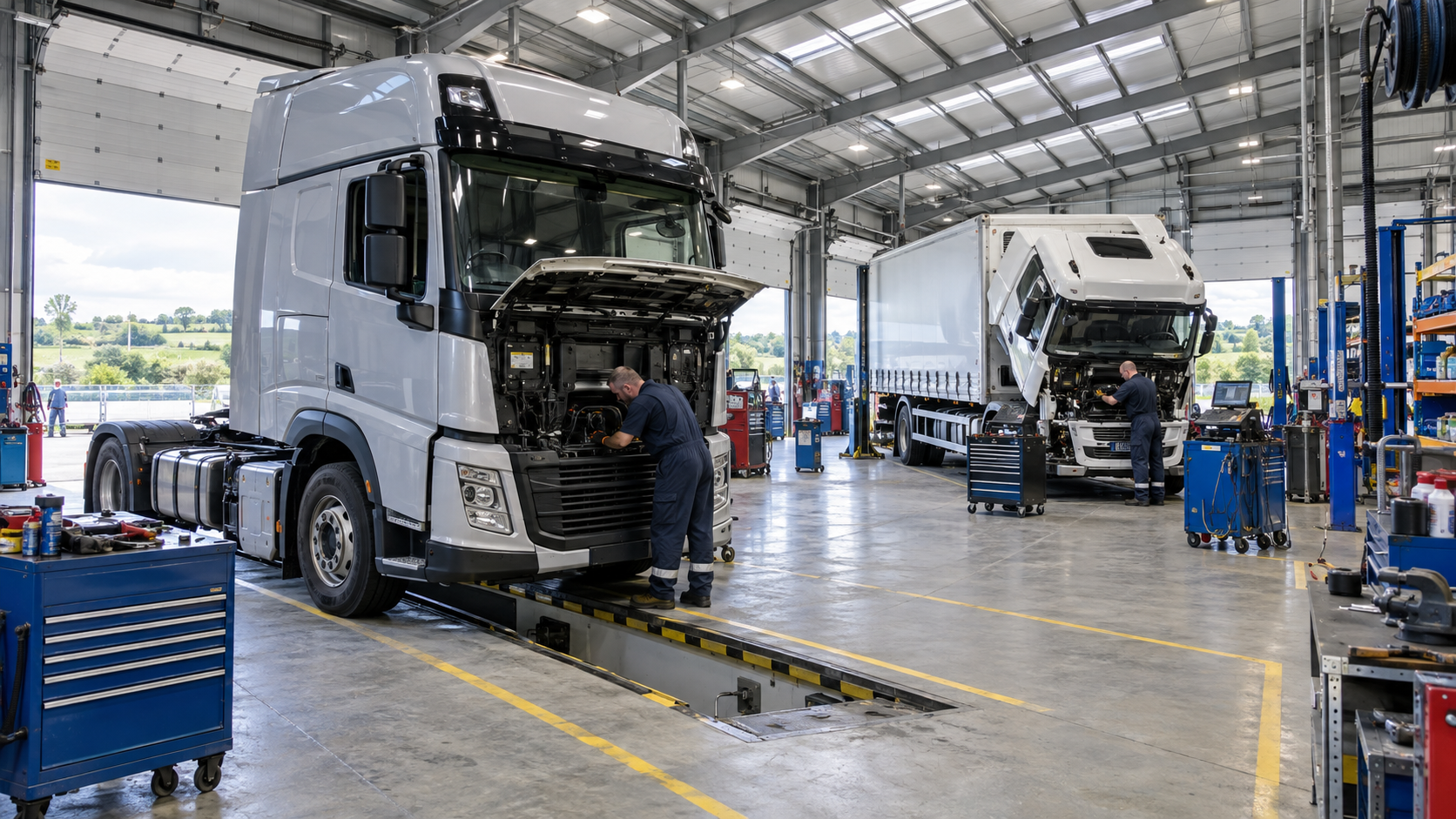
Increasing vehicle complexity
Modern commercial vehicles are effectively computers on wheels. Advanced driver-assistance systems, electronically controlled braking, emissions technology, telematics and multiple interconnected control units have transformed workshop operations.
A mechanical fault may now be accompanied by a software issue, sensor failure or communications problem. Diagnosing the underlying cause requires up-to-date equipment and technicians who understand how different systems interact.
Workshops consequently need access to multi-brand diagnostic platforms, technical data, wiring diagrams, software subscriptions and manufacturer-specific information. The cost does not end when the diagnostic equipment is purchased; licences, updates and technician training create continuing expenditure.
European legislation requires manufacturers to make vehicle repair and maintenance information available to independent operators. In practice, however, navigating different manufacturer portals, security procedures and subscription systems can still be complicated and expensive. EU rules on access to heavy-duty vehicle repair information cover technical manuals, wiring diagrams, fault codes, software calibration information and diagnostic data.
Pressure to reduce vehicle downtime
For a transport operator, a vehicle in the workshop is a vehicle that is not earning money. Customers therefore expect increasingly rapid diagnosis, immediate parts availability and accurate completion times.
That puts workshops under enormous pressure. A delayed component, an intermittent electronic fault or a requirement for manufacturer intervention can leave a truck occupying valuable workshop space for days.
Workshops must balance the customer’s demand for speed against the need to carry out a safe and complete repair. Rushing a job is not an option where braking, steering, suspension or vehicle stability systems are involved.
Clear communication is becoming essential. Customers need to understand what has been diagnosed, which parts are required, how long the repair is likely to take and why additional work may be necessary.
Rising business costs
Commercial vehicle workshops are being squeezed by higher wages, electricity, insurance, waste disposal, tooling, equipment calibration and property costs. Replacement parts and workshop consumables have also become more expensive.
At the same time, customers remain extremely price-conscious. Workshops can find it difficult to recover the full cost of diagnostic time, especially when identifying a fault takes longer than the physical repair.
Charging properly for technicians’ time will be essential. Diagnostic expertise, software access and specialist equipment represent real business costs and cannot continue to be treated as incidental additions to a repair invoice.
Investment requirements are also growing. Brake testers, lifts, wheel-alignment systems, air-conditioning equipment, ADAS calibration tools and diagnostic platforms all require capital expenditure, servicing and calibration.
Maintaining roadworthiness and compliance
Commercial vehicle workshops occupy a central position in Ireland’s roadworthiness system. They must help fleet operators maintain vehicles continuously—not simply prepare them shortly before a CVRT.
The latest published CVRT figures underline the scale of the challenge. During 2025, 29 per cent of trucks failed their initial full test, while 2.6 per cent of trucks undergoing full tests or retests recorded a dangerous failure. Suspension, brakes and chassis or frame attachments were the leading visual failure areas. CVRT statistics also show that 18 per cent of trailers failed their initial test.
These figures demonstrate why preventative maintenance, proper inspection records and effective defect-reporting systems matter. A workshop must not only complete the repair but also document what was found, what was done and which components were fitted.
Responsibility becomes more complicated when a customer declines recommended work or asks for only the minimum necessary repair. Workshops need robust authorisation procedures and written records to protect the business and reinforce its road-safety responsibilities.
Transition to alternative powertrains
Diesel will remain central to Irish road transport for some time, but workshops must prepare for battery-electric, hybrid, gas, biomethane and hydrogen-powered vehicles.
Battery-electric trucks bring different maintenance requirements, including high-voltage safety, battery management, thermal-control systems and electrically driven auxiliary equipment. Workshops may need insulated tools, protective equipment, dedicated working areas and technicians with the appropriate qualifications.
The difficulty is deciding when to invest. A workshop that moves too slowly risks losing future business, while one that invests prematurely may have expensive equipment sitting idle. The most practical approach is likely to involve phased training and investment based on the vehicles operated by existing customers.
Parts availability and quality
Supply-chain disruption has improved in some areas, but parts availability remains inconsistent. Ireland’s position at the edge of Europe means a component unavailable locally may add days to a repair.
Workshop operators also face a difficult balance between price and quality. Fleets understandably want to control maintenance expenditure, but fitting unsuitable or poor-quality parts can produce premature failures, repeat labour and further downtime.
Reliable suppliers, extensive local stock and accurate parts identification are therefore becoming increasingly valuable. The cheapest part is rarely the least expensive option if the vehicle returns with the same problem.
Turning challenges into opportunity
Despite these pressures, the outlook is not entirely negative. Ireland depends heavily on road transport, and commercial vehicles will always require maintenance, inspection and repair.
The workshops most likely to prosper will be those that invest in people, training, diagnostics and efficient management systems. They will also need to specialise, communicate their expertise and charge realistically for the value they provide.
The modern CV workshop is no longer merely a place where vehicles are repaired. It is a highly skilled technical operation that protects fleet productivity, regulatory compliance and road safety. The challenge for the industry is ensuring that customers—and the wider economy—recognise and support that value.